March 4, 2026
VEO 3.1 vs Grok Imagine: The Definitive 2026 AI Video Generation Showdown
A comprehensive comparison between Google's VEO 3.1 and xAI's Grok Imagine 1.0. Discover features, benchmarks, and which AI video tool is right for you.

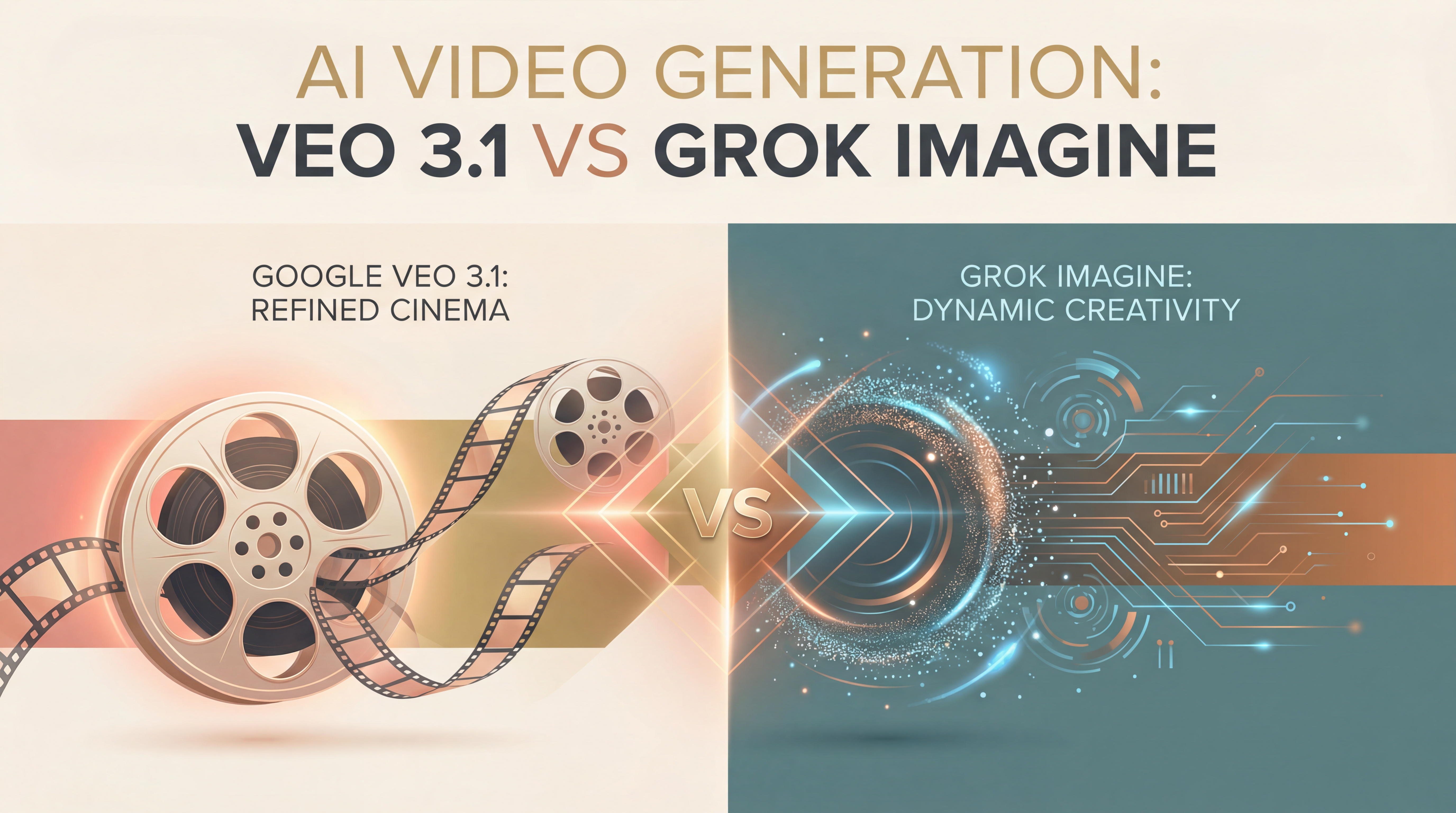
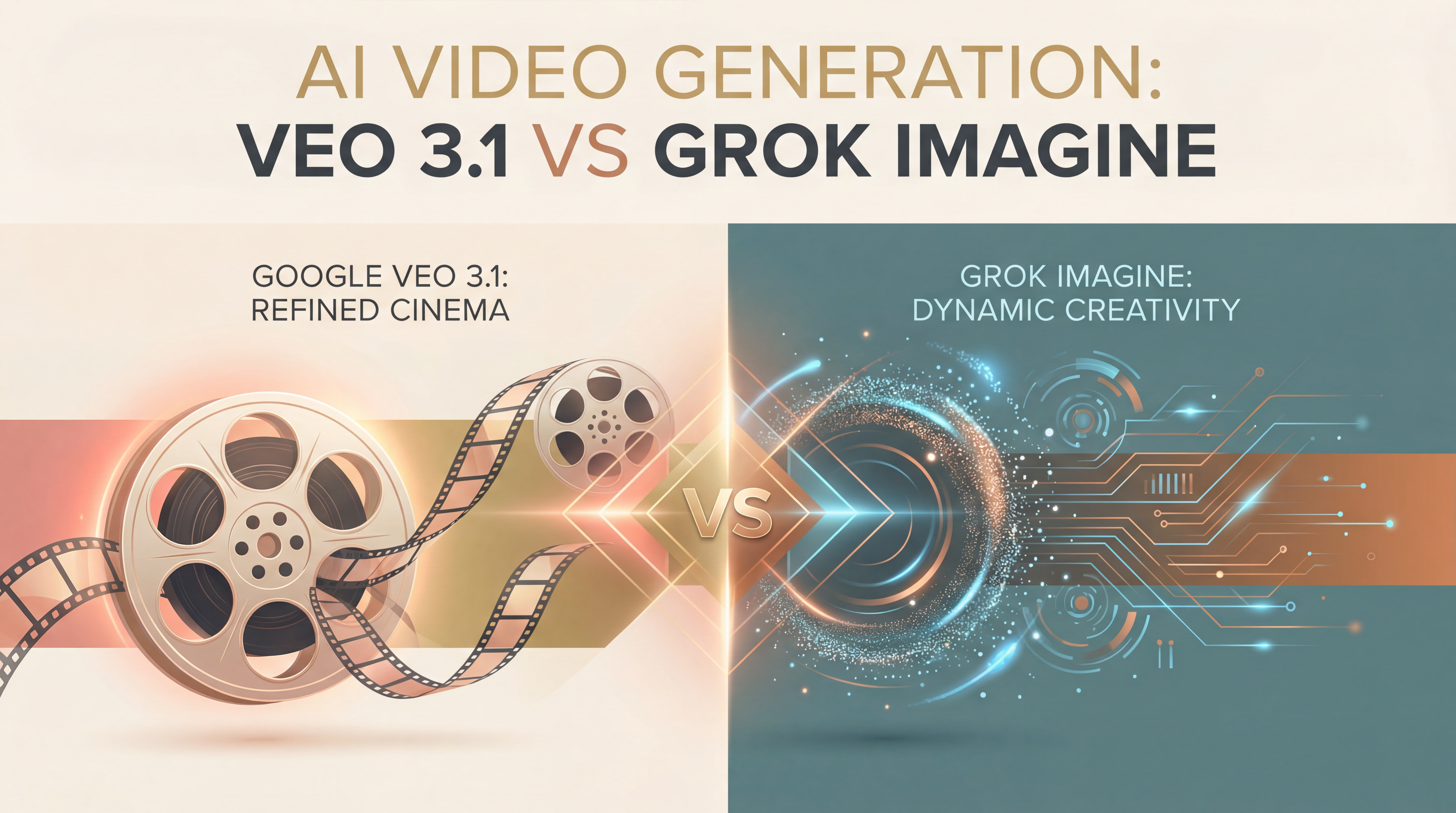
The AI video generation landscape has reached a watershed moment in early 2026. As content creators, marketers, and filmmakers navigate an increasingly crowded marketplace, two titans have emerged as the most compelling options: Google's VEO 3.1 and xAI's Grok Imagine 1.0. Both represent the cutting edge of what's possible when transformer architectures meet video synthesis, yet they approach the challenge from fundamentally different angles.
Choosing between these powerhouse models isn't simply about picking the "best" technology—it's about aligning capabilities with your specific workflow, budget constraints, and creative vision. This comprehensive guide cuts through the marketing hype to deliver the hard data, real-world performance benchmarks, and strategic insights you need to make an informed decision.
What Makes VEO 3.1 Google's Flagship Video AI
Google DeepMind's VEO 3.1, released in October 2025, represents the culmination of years of research into multimodal video generation. Building upon the foundation laid by VEO 3 at Google I/O in May 2025, the 3.1 update delivers substantial improvements in prompt understanding, audio generation, and creative control that position it as the professional's choice for cinematic content creation.
Native Audio Synchronization: A Game-Changer
What truly sets VEO 3.1 apart from earlier generations of AI video models is its unified approach to audio and video generation. While competitors typically generate silent footage that requires separate audio production workflows, VEO 3.1 produces synchronized dialogue, sound effects, and ambient noise alongside the visual content in a single pass.
The audio generation capabilities are remarkably sophisticated. The model generates speech at a 48kHz sample rate with stereo output and AAC encoding at 192kbps, achieving approximately 10ms latency between audio and video elements. For dialogue-heavy scenes, lip-sync accuracy has improved substantially compared to VEO 3, with testing showing synchronization within 120ms—sufficient to appear natural in most viewing contexts. The system supports multiple speakers and can handle conversation turn-taking, making it viable for narrative content creation.
Resolution and Format Flexibility
VEO 3.1 offers unprecedented flexibility in output specifications. The model generates native 1080p video that can be upscaled to 4K (3840×2160) resolution, making it the only AI video generator currently offering true cinema-grade output quality. Color science consistently receives praise from production professionals, with superior handling of mixed lighting conditions, natural skin tone reproduction, and better highlight and shadow detail retention compared to competitors.
Format support includes:
-
16:9 landscape for traditional video content, YouTube, and broadcast applications
-
9:16 vertical natively optimized for TikTok, Instagram Reels, and YouTube Shorts
-
Frame rates of 24, 30, or 60 fps to match various production standards
Base generation length starts at 8 seconds, but the scene extension feature allows chaining multiple clips to create videos exceeding 60 seconds while maintaining visual consistency across segments.
Ingredients-to-Video: Reference Image Control
One of VEO 3.1's most powerful features is "Ingredients to Video," which allows creators to upload up to three reference images that the model uses to maintain visual consistency. This feature proves invaluable for:
-
Brand identity maintenance across multiple scenes and prompts
-
Character consistency in narrative content
-
Style matching for established visual aesthetics
-
Product visualization with accurate color and form representation
By specifying first and last frames, creators can direct VEO 3.1 to generate specific transitions between scenes, adding a layer of narrative control previously unavailable in AI video generation.
Performance Benchmarks
Independent benchmarking using MovieGenBench and VBench places VEO 3.1 at the top tier across multiple metrics:
| Metric | VEO 3.1 Score | Industry Average |
|---|---|---|
| Prompt Adherence | 85-90% | 65-75% |
| Temporal Consistency | 8.9/10 | 7.2/10 |
| Anatomy Accuracy | 9.1/10 | 7.8/10 |
| Audio-Visual Sync | <120ms | 200-400ms |
| Overall Preference | Highest | — |
Grok Imagine 1.0: xAI's Disruptive Entry
While Google refined professional-grade video generation, xAI took a different approach with Grok Imagine 1.0, launched in February 2026. Rather than competing head-to-head on feature breadth, xAI optimized for speed, cost-efficiency, and accessibility—creating a tool that democratizes AI video creation without sacrificing core quality.
The Speed and Cost Advantage
Grok Imagine leverages an optimized autoregressive architecture that significantly reduces compute overhead. This technical choice enables xAI to offer cinematic motion generation at approximately 25% of the price of Google's flagship model, establishing Grok Imagine as the definitive "Value King" for high-volume production workflows.
The speed differential is equally dramatic. While VEO 3.1 may require several minutes for a single generation, Grok Imagine processes prompts in seconds. For creators who need to iterate rapidly—testing variations, exploring creative directions, or responding to trending topics—this efficiency transforms workflow possibilities.
Despite the cost and speed advantages, Grok Imagine currently holds the #1 position on Artificial Analysis benchmarks for text-to-video generation quality, scoring highly on visual quality, motion coherence, and prompt adherence.
Technical Specifications
Grok Imagine 1.0 generates clips up to 10 seconds in length at 720p resolution. While this falls short of VEO 3.1's maximum output quality, independent testing reveals the visual difference is minimal when viewed on standard displays or mobile devices. The model supports multiple aspect ratios including:
-
1:1 for social media posts
-
16:9 for traditional video content
-
9:16 for vertical mobile content
-
Widescreen formats for cinematic presentations
Native Audio and Multi-Shot Capabilities
Like VEO 3.1, Grok Imagine generates native audio alongside video output. The 1.0 release introduced significant audio quality improvements, with xAI demonstrating clips containing expressive, voiced characters. However, testing reveals that lip syncing remains a challenge—the video and audio don't always align perfectly, particularly in complex scenes with rapid dialogue or multiple speakers.
The "Temporal Latent Flow" technique treats static images as potential video frames, enabling image-to-video conversion that adds natural movement while maintaining the visual style of the original. Multi-shot scene capabilities allow for longer narrative sequences, though consistency can degrade in clips approaching the 10-second maximum duration.
X Platform Integration
For creators operating within the X (formerly Twitter) ecosystem, Grok Imagine offers seamless native integration. Videos generate and post without leaving the platform, streamlining workflows for social media managers and content creators who prioritize speed and convenience over maximum production values. This integration has driven explosive adoption—xAI reports approximately 1.245 billion videos created in the 30 days following the 1.0 release.
Head-to-Head: The Complete Comparison
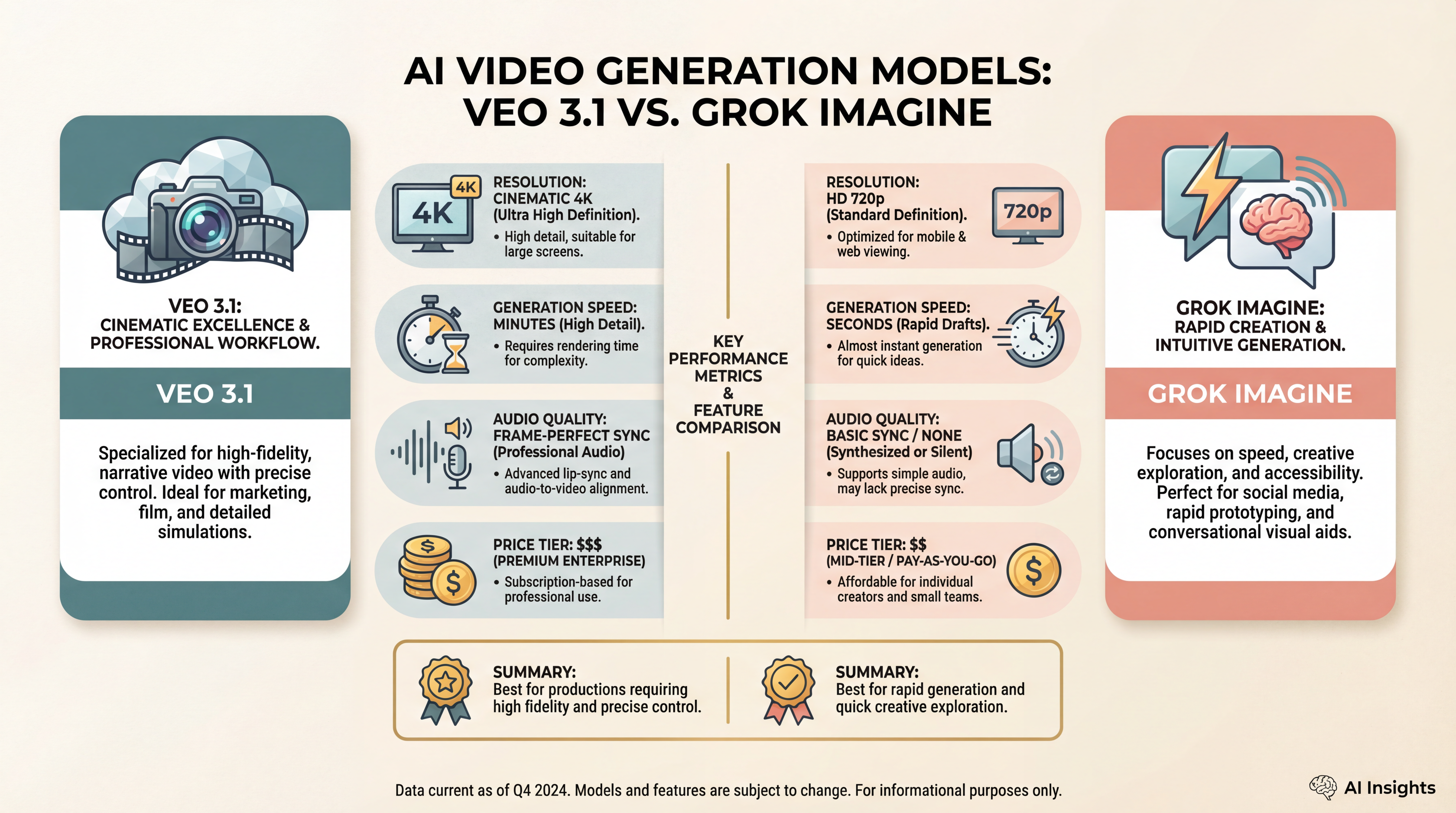
Understanding the theoretical capabilities of each model is valuable, but real-world performance determines which tool deserves your investment. This section examines how VEO 3.1 and Grok Imagine compare across the dimensions that matter most to working creators.
Video Quality and Realism
When evaluated on pure visual output quality, VEO 3.1 establishes itself as the industry benchmark. Professional blind testing reveals that VEO 3.1 produces the most visually polished output, with color science that production professionals consistently describe as "cinema-grade." The 4K output demonstrates superior color grading, more natural skin tones, and sophisticated handling of challenging lighting conditions.
Grok Imagine, while limited to 720p resolution, punches above its weight class. The model excels at generating "visual drama" with high contrast and intense lighting, making it particularly effective for concept art and poster-ready compositions. For content destined primarily for social media viewing on mobile devices, the resolution difference becomes nearly imperceptible.
In physics simulation testing using the Morpheus benchmark—which evaluates models against real physical experiments—both models show limitations. VEO 3.1 demonstrates a 25% improvement in temporal stability compared to its predecessor, particularly in fluid dynamics and object trajectory simulation. Grok Imagine struggles with complex physics encoding, though its performance continues to improve with each update.
Prompt Adherence and Control
The ability to accurately translate text descriptions into video content separates professional-grade tools from experimental toys. VEO 3.1 consistently outperforms competitors in multi-element prompt following and temporal consistency, achieving 85-90% accuracy when tested with specific cinematographic instructions including camera angles, lighting setups, and composition requirements.
Grok Imagine demonstrates impressive prompt understanding capabilities, particularly for creative and expressive content. The model handles follow-up prompts effectively, allowing iterative refinement of generated content. However, it occasionally struggles with complex multi-subject scenes where precise spatial relationships matter.
Generation Speed and Workflow Impact
For high-volume production environments, speed can be as important as quality. The following table compares workflow-relevant metrics:
| Feature | VEO 3.1 | Grok Imagine 1.0 |
|---|---|---|
| Average Generation Time | 2-5 minutes | 10-30 seconds |
| Maximum Clip Length | 8 seconds (extendable to 60+) | 10 seconds |
| Native Resolution | 1080p (4K upscaled) | 720p |
| Audio Generation | Native, synchronized | Native, variable sync quality |
| Reference Image Support | Up to 3 images | Limited |
| Daily Generation Limits | 4-5 quality videos (Ultra plan) | Higher limits on paid tiers |
Pricing and Value Analysis
Cost considerations ultimately determine which tool fits your budget. VEO 3.1 operates on a tiered subscription model:
-
Gemini Advanced: Approximately $20/month with generation limits
-
Ultra Plan: $249.99/month with fast mode and expanded limits
-
API Pricing: $0.40-0.75 per second depending on audio inclusion and quality settings
Even on the Ultra plan, daily generation caps apply—users report approximately 4-5 quality videos per day before hitting limits. High-volume production workflows may need to plan around this constraint or use the API for additional capacity.
Grok Imagine offers a more accessible entry point:
-
Free Tier: Basic generation with rate limits
-
SuperGrok: Expanded daily caps suitable for 2-3 videos per day
-
Enterprise: Starting around $54,000 for 12-month contracts with 100 licenses
-
API: Late January 2026 release with competitive pricing
At roughly 25% of VEO 3.1's cost per generation, Grok Imagine presents a compelling value proposition for creators prioritizing volume over maximum quality.
Choosing the Right Tool for Your Workflow
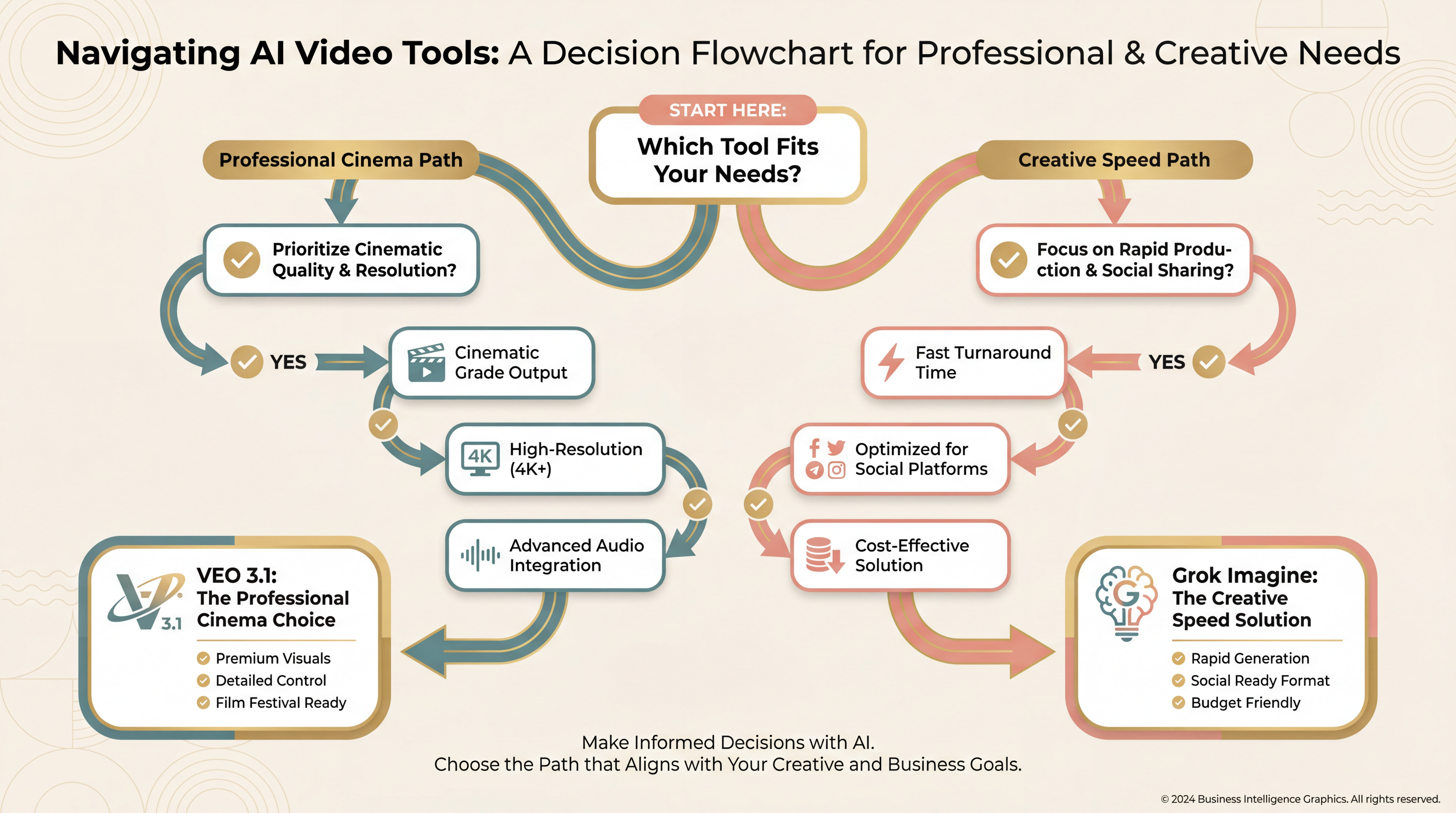
The optimal choice between VEO 3.1 and Grok Imagine depends entirely on your specific use case, technical requirements, and creative priorities. This decision framework helps identify which model aligns with your needs.
Choose VEO 3.1 If:
-
Professional cinema or advertising work requires 4K output and broadcast-quality color science
-
Character consistency across extended narratives is essential for your projects
-
Audio quality directly impacts final product value—lip-sync accuracy matters for dialogue-heavy content
-
Post-production workflows demand maximum headroom for color grading and effects
-
Budget allows for premium pricing in exchange for best-in-class output
-
Integration with Google's ecosystem (Vertex AI, Gemini API, Flow platform) streamlines existing workflows
Choose Grok Imagine If:
-
Social media content creation prioritizes speed and volume over maximum resolution
-
Rapid iteration is essential—testing multiple variations quickly matters more than perfect first-pass output
-
Budget constraints require cost-effective scaling for high-volume production
-
X platform presence means native integration provides meaningful workflow advantages
-
Concept art and visualization where "visual drama" and stylistic expression matter more than photorealism
-
Startup or indie production contexts where every dollar of tool investment must deliver maximum ROI
The Integrated Future: Why Platform Choice Matters More Than Model Choice
As the AI video generation landscape matures, a crucial insight emerges: individual model capabilities matter less than the platform ecosystem supporting them. The most sophisticated creators are increasingly turning to integrated platforms that provide access to multiple cutting-edge models through a unified interface.
This is where ImagenX and Grok Video Generator enter the picture as game-changing solutions.
ImagenX: Your Gateway to VEO 3.1 and Beyond
ImagenX offers creators seamless access to VEO 3.1 alongside other leading video generation models. Rather than managing multiple subscriptions, API keys, and workflow integrations, ImagenX provides a single platform where you can:
-
Generate high-quality video content using VEO 3.1's cinema-grade capabilities
-
Compare outputs across different models to select the best fit for each project
-
Manage reference images and brand assets consistently across all generations
-
Scale production without worrying about individual model rate limits or pricing complexity
ImagenX integrates and supports multiple cutting-edge video and image generation models, making operation incredibly convenient while providing users with a one-stop AI creation experience. For professional studios and serious content creators, this unified approach eliminates the fragmentation that slows production workflows.
Grok Video Generator: Democratizing AI Video Creation
grok imagine video genenrator extends the accessibility that makes Grok Imagine compelling into a full-featured production platform. The service amplifies xAI's core technology with:
-
Enhanced generation capabilities optimized for various content types
-
Simplified workflows that reduce the technical barrier to entry
-
Integration options that connect with popular editing and distribution tools
-
Cost structures designed for creators at every scale
Like ImagenX, Grok Video Generator embraces the philosophy that creators shouldn't be limited to a single model's capabilities. The platform provides a streamlined interface for accessing Grok Imagine's speed and efficiency while maintaining the flexibility to incorporate other tools as needed.
Advanced Techniques for Maximum Results
Regardless of which platform you choose, mastering advanced prompting and workflow techniques dramatically improves output quality. These strategies apply across both VEO 3.1 and Grok Imagine, though implementation details may vary.
Cinematic Prompt Engineering
The most effective video prompts follow a structured approach that guides the model through your creative vision:
-
Scene Setting: Establish location, time of day, and atmospheric conditions
-
Subject Definition: Describe characters, objects, or focal elements with specific details
-
Action Description: Define movement, interaction, or narrative progression
-
Camera Direction: Specify angles, movements (drone shots, Dutch angles, tracking), and framing
-
Lighting and Mood: Detail lighting conditions, color palettes, and emotional tone
-
Audio Requirements: For native audio models, describe soundscapes, dialogue, or effects
Example prompt structure:
"Aerial drone shot slowly descending through morning fog into a dense forest. Ancient redwood trees with moss-covered bark, shafts of golden sunlight piercing the canopy. Camera continues downward to reveal a small stream with crystal-clear water flowing over smooth stones. Ambient forest sounds with gentle water flow, peaceful and meditative atmosphere."
Reference Image Strategy
When using reference image features (particularly powerful in VEO 3.1's Ingredients-to-Video):
-
Use high-resolution source images that clearly show the visual elements you want to maintain
-
Limit references to essential elements—too many conflicting references confuse the model
-
Maintain consistent lighting across reference images for coherent output
-
Test variations with different reference combinations to find optimal results
Workflow Optimization
Professional creators typically develop hybrid workflows that leverage multiple tools:
-
Ideation Phase: Use fast, low-cost models (like Grok Imagine) for rapid concept exploration
-
Refinement: Iterate on promising concepts with higher-quality generation
-
Production: Deploy premium models (VEO 3.1) for final deliverables requiring maximum quality
-
Post-Processing: Apply traditional editing tools for final polish, color grading, and audio sweetening
The Road Ahead: What's Next for AI Video
The VEO 3.1 vs Grok Imagine comparison captures a moment in time, but the AI video generation landscape evolves rapidly. Several trends will shape the next generation of tools:
Longer Generation Durations: Both models currently max out at 8-10 seconds per generation (though VEO 3.1 extends through chaining). Future updates will likely push these boundaries toward true continuous video generation.
Improved Physics Simulation: As the Morpheus benchmark and similar evaluation frameworks drive competition, expect dramatic improvements in physical realism—accurate fluid dynamics, consistent object behavior, and natural collision response.
Multimodal Control: Beyond text and images, future models will accept storyboards, 3D scene files, motion capture data, and other creative inputs that give directors finer control over output.
Real-Time Generation: The gap between prompt and output continues to narrow. Real-time or near-real-time video generation will enable interactive creative experiences and live production workflows.
Ethical and Safety Considerations: As capabilities expand, so do concerns about deepfakes, misinformation, and content moderation. Both Google and xAI are investing heavily in detection tools and guardrails, though challenges remain.
Final Verdict: Two Paths to Video Excellence
The choice between VEO 3.1 and Grok Imagine ultimately reflects your creative priorities and production realities.
VEO 3.1 stands as the professional's choice—the tool you reach for when maximum quality, audio synchronization, and visual consistency matter above all else. Its cinema-grade output, sophisticated reference image control, and native 4K capabilities justify premium pricing for serious productions where every pixel counts.
Grok Imagine represents democratization—proof that impressive AI video generation doesn't require enterprise budgets. Its speed, cost-efficiency, and platform integration make it ideal for high-volume creators, social media managers, and anyone who prioritizes iteration speed over absolute perfection.
Rather than viewing this as an either/or decision, savvy creators increasingly adopt both tools—or better yet, access them through integrated platforms like ImagenX and grok imagine video genenrator. These services eliminate the friction of managing multiple subscriptions while providing the flexibility to match the right model to each creative challenge.
The future of video creation isn't about choosing sides—it's about having the right tool at the right moment. Whether you prioritize cinematic excellence or rapid iteration, today's AI video generation landscape offers capabilities that seemed like science fiction just months ago. The only question remaining is: what will you create?